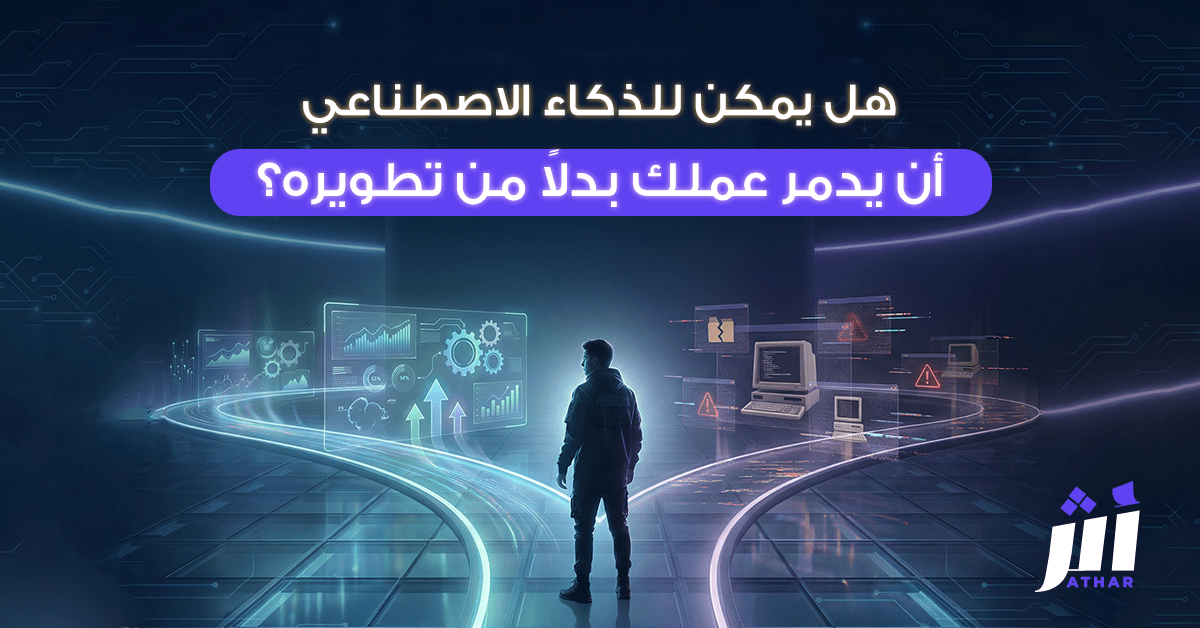
AI Risks in Business have become one of the most significant challenges facing business leaders today. While organizations are racing to adopt artificial intelligence, many are falling into hidden traps that can turn this powerful engine of growth into a source of serious disruption, putting business stability at risk.
Ahmed’s story represents a scenario that every business owner fears. Unfortunately, many companies can make similar mistakes when adopting artificial intelligence without sufficient planning, proper preparation, or effective oversight. When AI changes from a tool that accelerates growth into a force that causes substantial losses, the problem is not necessarily the technology itself. More often, it lies in the mindset and strategy guiding its implementation.
In this article, we explore the key reasons why artificial intelligence projects can become ticking time bombs within organizations, and how Athar Academy can help professionals and businesses develop the knowledge, strategic thinking, and leadership skills needed to use AI responsibly and effectively.
1. The Magic Wand Trap: When Technology Comes Before Strategy
Many business leaders are fascinated by the latest technology trends. They hear about the remarkable capabilities of ChatGPT, predictive analytics, or machine learning models and immediately decide to introduce these technologies into their organizations.
However, they often overlook one fundamental question: “What specific business problem are we actually trying to solve?”
The Dangerous Outcome: Automating Failure Instead of Addressing Its Causes
The Problem: Using artificial intelligence to conceal underlying management weaknesses rarely produces sustainable results. If your product is poor, automating customer service through an AI-powered chatbot will not magically increase sales. It may simply make receiving customer complaints faster and more efficient.
In this situation, you are not solving the real problem. You are simply automating failure.
The Athar Academy Perspective: AI as a Force Multiplier
At Athar Academy, we believe artificial intelligence should function as a Force Multiplier. It can enhance the effectiveness of a strong business strategy, but it cannot replace a clear vision or well-designed processes.
Think of it mathematically: if your strategy is worth zero, multiplying it by even the most advanced technology will still leave you with zero.
2. Data Poisoning: Garbage In, Garbage Out (GIGO)
One of the most important principles in data science and artificial intelligence is Garbage In, Garbage Out (GIGO), which means that the quality of a system’s outputs largely depends on the quality of its inputs.
In Ahmed’s story, the artificial intelligence model was highly sophisticated, yet it relied on inaccurate information as though it were trustworthy. The problem was not necessarily the model’s computational capabilities, but the quality and reliability of the data used to generate its predictions.
The Problem of Contaminated or Unreliable Data
Where Does the Problem Begin? Historical datasets may contain distortions or unusual factors that affect analytical results, such as exceptional promotional campaigns, sudden market disruptions like those experienced during the pandemic, or even simple human data-entry errors.
When organizations fail to properly clean, validate, and review their data, AI systems may generate outputs that appear technically accurate but are fundamentally disconnected from business reality.
The Financial Risk: Million-Riyal Decisions Built on Unstable Foundations
The Financial Danger: Making purchasing or investment decisions worth millions of Saudi riyals based on unreliable AI predictions is not effective business management. It represents a significant financial risk.
Without strong data quality practices, organizations may place excessive confidence in predictions built on incomplete, misleading, or inaccurate information.
3. The Technological Tower of Babel: Bridging the Gap Between Data and Business Value
Many organizations struggle with a significant communication gap between their technical teams and senior management.
Technical specialists operate in a world of algorithms, models, and programming languages, while business executives focus on revenue, operational efficiency, and Return on Investment (ROI).
A Realistic Scenario: An Intelligent Model That Delivers No Business Value
Imagine a Data Scientist developing an advanced machine learning model capable of predicting customer churn with an impressive accuracy rate of 99%.
From a technical perspective, this model might represent an extraordinary achievement. However, if the marketing department does not understand how to turn those predictions into effective customer retention campaigns, the model may deliver very limited business value, or perhaps no measurable impact at all.
An impressive algorithm is not necessarily a successful business solution.
The Organizational Challenge: Connecting the Language of Code with Business Strategy
Artificial intelligence initiatives require professionals who can bridge the gap between technical capabilities and commercial objectives.
These individuals understand both the language of technology and the language of business. They can translate technical findings into practical recommendations that deliver genuine, measurable value to organizations.
4. Silent Resistance: The Human Factor Behind AI Project Failure
Many organizations underestimate one of the most important factors in successful technological transformation: their employees.
When employees believe artificial intelligence threatens their jobs and livelihoods, they may resist its implementation, sometimes without openly expressing their concerns.
Unintentional Disruption: How Employee Fear Can Undermine AI Systems
For example, a sales employee who fears being replaced by an AI-powered system may become less careful when entering customer information or may simply ignore the system’s recommendations.
Over time, inconsistent data entry, limited engagement, and poor system adoption can reduce data quality and negatively affect the performance of the entire AI solution.
Even the most advanced algorithms cannot deliver reliable results when the people responsible for supporting them are unwilling or unable to participate effectively.
A Culture of Fear: The Hidden Enemy of AI Transformation
Without an organizational culture that addresses employee concerns and demonstrates how AI can support their work rather than simply replace them, technology may remain unfamiliar, mistrusted, and underutilized.
Successful AI adoption therefore requires far more than installing and operating technical systems. It also demands transparent communication, employee involvement, appropriate training, and effective change management.
How Can You Protect Your Business from AI Risks?
Success in the age of artificial intelligence is not about joining a race to acquire the latest technologies. It requires a fundamental shift in leadership approaches, strategic thinking, and organizational readiness for change.
At Athar Academy, we focus on a structured approach that helps professionals and organizations understand how to turn artificial intelligence into a valuable business partner rather than an uncontrolled source of risk.
First: Define Clear Strategic Objectives
Before writing a single line of code, organizations must identify the real business challenge they want to address.
Are you trying to reduce operational costs? Improve customer satisfaction? Predict future demand? Increase sales? Or optimize internal processes?
Artificial intelligence solutions should be selected and implemented based on clearly defined objectives.
Technology must serve the strategy, not the other way around.
Second: Build a Strong Foundation of Data Quality
Investing in data cleaning, validation, organization, and governance can be far more valuable than simply purchasing the latest artificial intelligence algorithms.
At Athar Academy, we emphasize the importance of developing reliable data infrastructure and building practical skills in Data Engineering and Data Analytics.
These foundations help organizations make decisions based on accurate, consistent, and trustworthy information rather than unstable assumptions.
Third: Bridge the Skills Gap Through Workforce Development
Developing successful AI solutions requires more than teaching people how to write code.
Organizations need professionals who understand business objectives, recognize technological limitations, and know how to apply digital tools to solve practical challenges.
At Athar Academy, our educational approach focuses on preparing professionals who can connect technical knowledge with real-world business needs.
Investing in people is one of the most important factors in maximizing the value of investments in artificial intelligence and automation.
Fourth: Lead AI Transformation with Awareness and Responsibility
Artificial intelligence requires knowledgeable leadership, human oversight, and responsible decision-making.
Think of a modern Boeing aircraft. Although advanced automation systems can manage many aspects of a flight, the aircraft still relies on trained pilots who know when to intervene during unexpected situations.
AI systems should be managed with a similar philosophy: use automation to improve efficiency while ensuring that qualified professionals remain responsible for oversight, critical decisions, and risk management.
Final Thoughts:
Artificial intelligence is not a storm that businesses must hide from. It is a powerful wind that can propel your organization toward extraordinary opportunities or drive it into dangerous waters if you do not know how to control the sails.
Ahmed had the wind, but he did not have the compass.
Now, the Question Is Yours:
Will you wait until your organization faces a crisis similar to Ahmed’s experience before taking action? Or will you choose today to become the leader who guides artificial intelligence toward meaningful business success and measurable results?
At Athar Academy, we help you develop the knowledge, practical skills, and strategic understanding needed to navigate the rapidly evolving world of artificial intelligence.
Are you ready to move your team beyond the excitement of new technology and toward measurable business value, stronger operational control, and sustainable growth? Connect with Athar Academy today and discover how intelligent technology can support your organization’s future.
Frequently Asked Questions About AI Risks in Business
What Are the Main AI Risks Businesses Should Avoid?
The most significant risks include adopting artificial intelligence without a clear business strategy, relying on poor-quality or contaminated data, failing to establish effective communication between technical teams and management, and overlooking employee concerns about automation and job security.
How Do I Know Whether AI Is Right for My Business?
Before implementing an AI-powered solution, ask yourself three essential questions: What specific problem am I trying to solve? Is my data accurate, reliable, and suitable for the intended application? Is my team prepared to adopt and manage the technology effectively?
If you cannot answer these questions clearly, your organization may need a strategic roadmap before investing in AI implementation.
What Is the Difference Between AI as a Growth Engine and AI as a Business Risk?
Artificial intelligence acts as a Force Multiplier. When an organization has a strong strategy, reliable data, and a capable team, AI can improve productivity, enhance decision-making, and accelerate growth.
However, when a business suffers from weak management processes, unreliable information, or inadequate preparation, AI may amplify those existing problems rather than solve them.
How Does Athar Academy Help Professionals and Businesses Avoid AI Risks?
Athar Academy promotes a comprehensive approach to developing AI-related capabilities. This approach begins with understanding strategic business objectives, establishing strong data quality practices, developing workforce skills, and encouraging responsible leadership that connects technological capabilities with real market requirements.
The goal is to help professionals and organizations use artificial intelligence as a practical tool for sustainable success rather than allowing poor implementation to become a source of business failure.